
Miami Lakes Veterinary Clinic
Request an Appointment

15504 NW 77th Ct

Miami Lakes, FL 33016 US

305-362-5777

Open mobile navigation
  • Home
  • New Patient Center
    • Online Forms
    • What to Expect
    • Veterinary Resources
    • Payment Options
    • Request An Appointment
  • About Us
    • Services
    • Office Tour
    • Dr. Manny Morales
    • Dr. Maria Silva
    • Ms. Cynthia Colina
    • Meet Our Team
  • Contact Us
  • Pet Portal
  • Puppy and Kitten Pack Special
  • Pet Gallery
  • Veterinary Topics
    • Pet Health
      • Chronic Conditions
      • Digestive and Oral Health
      • Diseases and Viruses
      • Pests and Parasites
      • Orthopedics
    • Today's Veterinarian
    • Choosing Your Pet
      • Finding Your Pet
      • Cats
      • Dogs
      • Exotics
        • Amphibians
        • Birds
        • Reptiles
          • Lizards
          • Turtles
      • Small Mammals
        • Ferrets
        • Rabbits
        • Domesticated Animals
          • Prairie Dogs
        • Pocket Pets
          • Chinchillas
          • Guinea Pigs
          • Hamsters
          • Hedgehogs
          • Rats
      • Livestock
        • Cows
        • Donkeys, Horses & Mules
        • Goats
        • Pigs
        • Poultry
        • Sheep
    • Living With Your Pet
      • Bringing Your Pet Home
      • Children and Pets
      • Providing Care
      • Travel
      • Saying Goodbye
    • Newsletter Library
      • Cats
      • Tips for Pet Owners
      • Behavior & Training
      • Fleas & Parasites
      • Keeping Pets Healthy
      • Recognizing Illness
      • Nutrition & Food
      • Pet Dangers
      • Seasonal Topics
      • Visiting the Vet
      • Equine
      • Newsletter Archive
        • Fun with Pets
        • Unbelievable Pets
    • Video Newsroom
      • Health Topics
      • Technology and Science
      • Other Interests
    • Newsletter Library
    • Client Survey
    • Pets4Kids
  • Shop Food & Meds
  • Home >
  • Articles >
  • Choosing Your Pet >
  • Exotics >
  • Reptiles >
  • Lizards >
  • Green Anoles

Green Anoles

  • Created in Choosing Your Pet, Exotics, Reptiles, Lizards

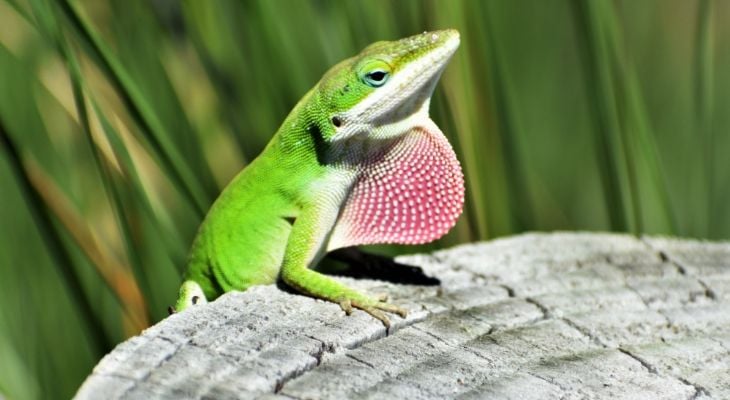
green anoles

  • Species: Anolis carolinensis.
  • Sometimes also called American chameleons, although they are not true chameleons. They can do a color change from green to brown, especially when stressed.
  • Quite readily available in the pet trade.
  • Life span averages around 4 years, although they can live longer (up to 8 or more years if well cared for).
  • Adult length of around 8 inches (including tail) in captivity (typically slightly larger in the wild).
  • Males are larger than females and have a large dewlap (flap of skin) on the throat that is used in behavioral displays.
  • Usually inexpensive to buy an anole, but the equipment needed to set up a proper tank is quite costly.
  • Reasonably easy to care for if you can set up a proper tank.
  • Can be very stressed by handling, and can drop their tails if grabbed by the tail.

Setting Up the Tank

  • Anoles can be housed in a fairly small tank - a 10 gallon is sufficient for a single anole, or perhaps a pair. Larger is better, and if housing multiple anoles, lots of space is necessary. You should only keep one male anole per tank. Females will get along fine, as long as the tank is roomy enough and there plenty of basking spots and places to hide. A secure fitted lid is necessary.
  • Substrate/furnishings: A substrate of peat moss and soil with or without a layer of bark (e.g. orchid bark) is an ideal substrate for anoles. Live plants help maintain humidity and provide cover - try Sansevierias (snake plants), bromeliads, philodendrons, ivy, orchids and vines. Pieces of bark and branches should also be provided for climbing and basking.
  • Temperature: during the day, provide a gradient from 75-80 F (24-27 C) with a basking spot of 85-90 F (29-32 C). A combination of under tank heating and a basking light on one side of the tank works well. Make sure the appropriate temperature gradient is provided by measuring temperatures in various spots around the tank. Night temperature can drop to a gradient of 65-75 F (18-24 C). Do not use basking lights to achieve night time temperatures - use heating pads and/or ceramic heating elements.
  • Light: in addition to the incandescent basking light, provide a full spectrum UVA/UVB light for 10-12 hours per day.
  • Water and Humidity: a humidity level of 60-70% is necessary for anoles. This can usually be achieved by misting the inside of the tank daily. It is a good idea to measure the humidity level to make sure it is adequate for anoles. Misting systems are available although they are quite expensive. If you are having a hard time maintaining the humidity level, try covering part of the top of the tank and/or increasing the number of live plants. Misting also provides drinking water for the anoles as they often will not drink from a bowl (they will lick droplets of water off the misted plants).

Feeding

  • Anoles are insectivores and are generally good eaters.
  • While crickets can be the main part of the diet, it is best to feed a variety of insects. Wild caught insects can be offered as well, if pesticide free.
  • Crickets must be gut loaded with nutritious food prior to feeding.
  • Feed appropriate sized prey items - about 1/2 the size of the anole's head is a good guideline.
  • Can usually feed every other day, and 2-3 appropriately sized items per feeding.
  • Crickets and other prey should be dusted with a quality vitamin/mineral supplement.
  • Pet Health
    • Chronic Conditions
    • Digestive and Oral Health
    • Diseases and Viruses
    • Pests and Parasites
    • Orthopedics
  • Today's Veterinarian
  • Choosing Your Pet
    • Finding Your Pet
    • Cats
    • Dogs
    • Exotics
      • Amphibians
      • Birds
      • Reptiles
        • Lizards
        • Turtles
    • Small Mammals
      • Ferrets
      • Rabbits
      • Domesticated Animals
        • Prairie Dogs
      • Pocket Pets
        • Chinchillas
        • Guinea Pigs
        • Hamsters
        • Hedgehogs
        • Rats
    • Livestock
      • Cows
      • Donkeys, Horses & Mules
      • Goats
      • Pigs
      • Poultry
      • Sheep
  • Living With Your Pet
    • Bringing Your Pet Home
    • Children and Pets
    • Providing Care
    • Travel
    • Saying Goodbye
  • Newsletter Library
    • Cats
    • Tips for Pet Owners
    • Behavior & Training
    • Fleas & Parasites
    • Keeping Pets Healthy
    • Recognizing Illness
    • Nutrition & Food
    • Pet Dangers
    • Seasonal Topics
    • Visiting the Vet
    • Equine
    • Newsletter Archive
      • Fun with Pets
      • Unbelievable Pets
  • Video Newsroom
    • Health Topics
    • Technology and Science
    • Other Interests
  • Newsletter Library
  • Client Survey
  • Pets4Kids

New Client Receives $25 Credit on First Visit!

Error!

    Featured Services

    • Services

    • Request Appointment

    • Online Forms

    Office Hours

    Our Regular Schedule

    Monday:

    7:00 am-7:00 pm

    Tuesday:

    7:00 am-5:00 pm

    Wednesday:

    7:00 am-7:00 pm

    Thursday:

    7:00 am-5:00 pm

    Friday:

    7:00 am-5:00 pm

    Saturday:

    7:00 am-12:00 pm

    Sunday:

    Closed

    Testimonial

    Read What Our Client Say

    • "Dr. Manny Morales has always gone above and beyond for the care of our family's pets for several years."
      Lina Rojas - Miami Lakes, FL

    Newsletter Sign Up

    Sign up for more articles

    Error!

      Connect With Us

      • Copyright © 2026 MH Sub I, LLC dba iMatrix.
      • Admin Log In
      • Site Map